
Start with a clear use case
Write down where the machine will live, who will move it, who will use it and which exercises the manual allows. Decide whether you want a compact platform or a permanent upright station. If your main goal is treatment of a condition, first discuss whether vibration equipment is appropriate with a qualified clinician.
Understand the movement
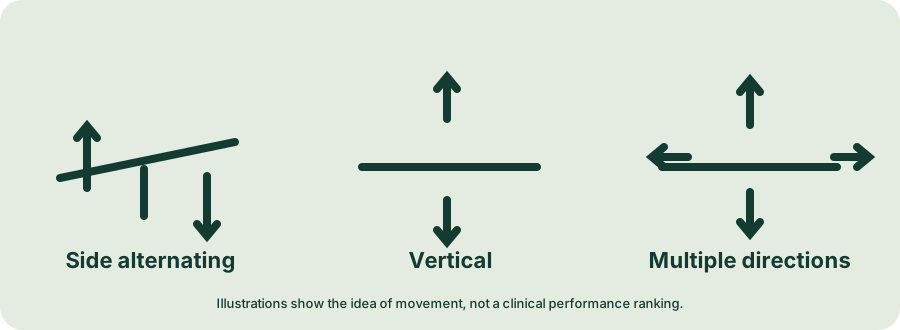
Side-alternating or pivotal platforms tilt around a centre point. Vertical platforms move mainly up and down. Multi-mode machines combine different motions. Marketing labels such as “3D” and “4D” are not a standardised grading system. Ask what the platform physically does in each mode.
Read these specifications together
| Specification | What the source lists |
|---|---|
| Frequency (Hz) | How many cycles occur per second. Ask for the range in each mode. |
| Amplitude / displacement (mm) | How far the platform moves. Check whether the number is peak or peak-to-peak. |
| Acceleration (g) | Depends on frequency and movement; ask how and where it was measured. |
| Speed levels | A model-specific control scale, not a physical measurement. |
| Motor power (W) | Electrical or advertised motor rating; not a direct measure of workout quality. |
| User limit | A maximum for the exact product, not a target or a guarantee of suitability. |
Higher is not automatically better. Different measurement conventions, modes and foot positions can make headline numbers misleading. If a seller cannot define a figure, do not use it to rank machines.
Measure the real space
- Mark the entire footprint on the floor, including the upright column if there is one.
- Leave access space according to the manual, with a clear route on and off.
- Check height under furniture and whether there is a safe grip for moving the machine.
- Plan around stairs, thresholds, cable length and the position of the socket.
- Ask about vibration transmitted into the floor; motor noise is only part of the disturbance.
Make everyday use easy
Look for a readable display, reachable start and stop controls and straightforward manual settings. Check whether a missing remote can be replaced. Resistance bands and cords are exercise accessories; do not assume they are designed to prevent a fall. A fixed rail also needs to be used only as its manual permits.
Compare the complete ownership cost
Add delivery, assembly, a suitable floor arrangement, replacement accessories and return shipping to the asking price. Read the motor, electronics, labour and commercial-use terms separately. “Lifetime motor warranty” may leave much of the machine outside that cover. Ask whether you must register the product.
If you are buying used
- Get the model code, serial label and original manual before travelling.
- Ask about faults, storage conditions and maintenance.
- Inspect cables, casing, grip surfaces and fixings. Use a competent technician if electrical safety is uncertain.
- Request a normal-operation demonstration without asking anyone to use an unsafe setting.
- Check ownership, included accessories, seller terms and replacement parts.
A final five-point check
- I know the exact model and version.
- I can store, position and move it safely.
- I understand the intended controls and instructions.
- I have checked the seller’s returns and warranty.
- I have realistic expectations and have considered personal suitability.